
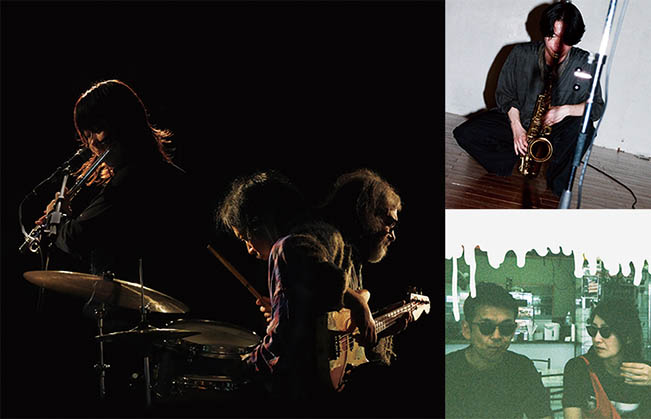
Kafka’s Ibiki
5/30(Sat)
Open19:00 /
Start19:30
Ticket on the day:4,400 yen 4,000 yen + tax (one drink included)
MEMBERS
Jim O'Rourke (b, synth), Eiko Ishibashi (key, p), Tatsuhisa Yamamoto (ds), Guest: 30th TORSO【Kenji (sax, fl), Orie (cello, voice)】
TOPICS
*Tickets (reservations accepted) are available in advance by phone (03-3354-2024) or through the online ticket reservation form for each concert date on our website.
A priority entrance number is given at the time of reservation.
*Admission to the ' Kafka’s Ibiki ' concert will be in the order of ticket number, so if you have already made a reservation for a ticket, please be sure to purchase your reserved ticket at the Pit Inn reception desk.
*Numbers are assigned at the time of reservation.
*Tickets are available for purchase prior to the performance date.
Requests to Our Customers
Please be aware that the venue will be very crowded if you try to purchase your ticket reservations shortly before the opening time of 19:00. In order to avoid the congestion and ensure a smooth opening, we will start accepting reserved ticket purchases at the reception desk starting at 18:00. We apologize for the inconvenience, but we would like to ask for your cooperation in purchasing tickets early in the time difference. After purchase, you will be able to enter the venue in numerical order upon your return at 19:00 when the venue opens. Thank you for your cooperation.
Thank you for your continued support every year. On the first day of this year’s event, the 29th, we’ll be welcoming Kei Matsumaru, and on the second day, the 30th, we’ll be welcoming TORSO - two fresh and diverse acts. We at Kafka’s Ibiki are eager to incorporate new inspiration through their performances. We’ve asked both acts to share their thoughts in a Q&A format, so please be sure to check them out on the Pit Inn website.
I asked the two groups of guests some questions.
⚫ Kei Matsumaru (as, ss, electronics) *Guest on May 29
Q1: What do you think of Kafka’s Ibiki?
They were among the first people I met when I came to Japan seven years ago, and they’ve always looked out for me both professionally and personally - inviting me to various events and participating in my projects. They’re seniors I deeply respect as musicians, and at the same time, they’re very dear to me personally.
The live show in May feels like visiting the home of an older sibling or relative for the first time.
Q2: How do you view the connection between your own activities and jazz?
I grew up in an environment with extremely limited access to information—not just music—so from the time I started playing the saxophone at age 12 or 13, I assumed that saxophone equaled jazz. I taught myself to play and eventually went to a music college in the U.S. to study jazz. I believed that traditional “jazz” was the pinnacle of music, and there were many teachers and students around me who (indirectly, and sometimes directly) rejected other genres or approaches that bordered on jazz. However, while I was in school, I learned that when tracing history and context, the musicians who built what is classified as “jazz” actually disliked—both calling it and being called—this multifaceted art form, which was created through the complex interweaving of various cultures, as a single, monolithic entity.
For me, it is not something flat and easily understood that I can simply “dress up” as a tool, nor do I have any desire to imitate what is currently classified as “jazz” (retrospectively or academically). My ideal is to continue learning and growing through various forms of music, including jazz, and to keep creating music in the moment with musicians who are willing to play alongside me, expressing ourselves through the music we create together.
Q3, What does improvisation mean to you?
It is a special experience that holds the potential to provide an irreplaceable sense of liberation, along with challenges not encountered in other situations, while performing.
The music progresses based on a complex interplay of various elements—not only melody, rhythm, harmony, and dynamics, but also the timbre, texture, vertical and horizontal density of sound, the passage of time, and the use of pauses presented by all the performers in the moment. It is both intellectual and physical, and can be approached both deliberately and instinctively.
While I wouldn’t say there is no room for academic or competitive values, the difficulty of analyzing and categorizing the music means it is never completely dominated by them. Therefore, I believe it is a space that constantly holds new musical and perceptual possibilities.
Q4: Please feel free to add any comments.
I’m really happy to be playing with Kafka’s Ibiki at Pit Inn again after such a long time. I’m super excited.
⚫ TORSO (KENJI sax, fl / ORIE cello, voice) *Guest on May 30
Q1, What do you think of Kafka’s Ibiki?
A legend!
Q2. How do you view the connection between your own activities and jazz?
I feel like I've been abandoned by jazz.
Q3. What does improvisation mean to you?
Imagination
Q4: Please feel free to add any comments.
A session with Kafka’s Ibiki—and finally at PIT INN! Someday is today!
A priority entrance number is given at the time of reservation.
*Admission to the ' Kafka’s Ibiki ' concert will be in the order of ticket number, so if you have already made a reservation for a ticket, please be sure to purchase your reserved ticket at the Pit Inn reception desk.
*Numbers are assigned at the time of reservation.
*Tickets are available for purchase prior to the performance date.
Requests to Our Customers
Please be aware that the venue will be very crowded if you try to purchase your ticket reservations shortly before the opening time of 19:00. In order to avoid the congestion and ensure a smooth opening, we will start accepting reserved ticket purchases at the reception desk starting at 18:00. We apologize for the inconvenience, but we would like to ask for your cooperation in purchasing tickets early in the time difference. After purchase, you will be able to enter the venue in numerical order upon your return at 19:00 when the venue opens. Thank you for your cooperation.
Thank you for your continued support every year. On the first day of this year’s event, the 29th, we’ll be welcoming Kei Matsumaru, and on the second day, the 30th, we’ll be welcoming TORSO - two fresh and diverse acts. We at Kafka’s Ibiki are eager to incorporate new inspiration through their performances. We’ve asked both acts to share their thoughts in a Q&A format, so please be sure to check them out on the Pit Inn website.
I asked the two groups of guests some questions.
⚫ Kei Matsumaru (as, ss, electronics) *Guest on May 29
Q1: What do you think of Kafka’s Ibiki?
They were among the first people I met when I came to Japan seven years ago, and they’ve always looked out for me both professionally and personally - inviting me to various events and participating in my projects. They’re seniors I deeply respect as musicians, and at the same time, they’re very dear to me personally.
The live show in May feels like visiting the home of an older sibling or relative for the first time.
Q2: How do you view the connection between your own activities and jazz?
I grew up in an environment with extremely limited access to information—not just music—so from the time I started playing the saxophone at age 12 or 13, I assumed that saxophone equaled jazz. I taught myself to play and eventually went to a music college in the U.S. to study jazz. I believed that traditional “jazz” was the pinnacle of music, and there were many teachers and students around me who (indirectly, and sometimes directly) rejected other genres or approaches that bordered on jazz. However, while I was in school, I learned that when tracing history and context, the musicians who built what is classified as “jazz” actually disliked—both calling it and being called—this multifaceted art form, which was created through the complex interweaving of various cultures, as a single, monolithic entity.
For me, it is not something flat and easily understood that I can simply “dress up” as a tool, nor do I have any desire to imitate what is currently classified as “jazz” (retrospectively or academically). My ideal is to continue learning and growing through various forms of music, including jazz, and to keep creating music in the moment with musicians who are willing to play alongside me, expressing ourselves through the music we create together.
Q3, What does improvisation mean to you?
It is a special experience that holds the potential to provide an irreplaceable sense of liberation, along with challenges not encountered in other situations, while performing.
The music progresses based on a complex interplay of various elements—not only melody, rhythm, harmony, and dynamics, but also the timbre, texture, vertical and horizontal density of sound, the passage of time, and the use of pauses presented by all the performers in the moment. It is both intellectual and physical, and can be approached both deliberately and instinctively.
While I wouldn’t say there is no room for academic or competitive values, the difficulty of analyzing and categorizing the music means it is never completely dominated by them. Therefore, I believe it is a space that constantly holds new musical and perceptual possibilities.
Q4: Please feel free to add any comments.
I’m really happy to be playing with Kafka’s Ibiki at Pit Inn again after such a long time. I’m super excited.
⚫ TORSO (KENJI sax, fl / ORIE cello, voice) *Guest on May 30
Q1, What do you think of Kafka’s Ibiki?
A legend!
Q2. How do you view the connection between your own activities and jazz?
I feel like I've been abandoned by jazz.
Q3. What does improvisation mean to you?
Imagination
Q4: Please feel free to add any comments.
A session with Kafka’s Ibiki—and finally at PIT INN! Someday is today!
RELATIONAL LINK